
You’ve seen the pitch. A fully automated Amazon store that generates passive income while you sleep. The sales page is polished. The testimonials look real. And the operator wants $25,000 upfront to “get you started.”
If that sounds familiar, you’re not alone. Every month, thousands of aspiring sellers hear the same pitch: hands-free Amazon income. Many end up losing thousands to Amazon automation scams that deliver empty dashboards, weak results, and unanswered emails.
An automated Amazon store scam involves operators charging $20,000–$50,000 upfront to manage your Amazon FBA business, then delivering few or no results. Legitimate Amazon automation services exist; they give you full Seller Central access, use authorized suppliers, and report real data. This guide reveals 15 red flags to spot the difference before you invest.
Whether you’re starting an Amazon business or vetting an agency, Brandock, your trusted Amazon automation experts, built this guide to help you make a safe decision. We have revealed 15 red flags to spot the difference before you invest.
What “Automated” Means In The Amazon Store Context
An automated Amazon store is a Fulfillment by Amazon (FBA) or Fulfillment by Merchant (FBM) business where a third-party operator handles day-to-day tasks on your behalf.
These tasks can include product sourcing, listing creation, Pay-Per-Click (PPC) advertising, inventory management, and order fulfillment. You own the Amazon Seller Central account. The operator manages the work inside it.
In theory, this model makes sense. Amazon’s selling involves dozens of repeatable processes that benefit from specialization. The problem starts when “automation” is used as a marketing buzzword to sell something that isn’t a real service at all.
How Legitimate Amazon Automation Differs From Automated Amazon Store Scam Services
A real e-commerce automation solutions provider gives you full access to your Amazon Seller Central dashboard at all times.
You can see every product listed, every ad dollar spent, and every sale made.
A scam service does the opposite; it obscures reporting, blocks access, and relies on you not understanding the platform well enough to ask the right questions.
The core difference is transparency. If you can log in to your own account and verify every claim the operator makes, you’re likely working with a real agency. If you can’t, you’re likely the product, not the partner.
The Difference Between A Managed Done-For-You Amazon Store And A Passive Income Scheme
A done-for-you Amazon store is a legitimate service model. A passive income scheme is a marketing angle designed to sell that model to people who don’t understand it.
The difference matters. A real agency will tell you upfront that Amazon selling involves risk and that margins vary by product category.
They will also tell you that profitability depends on execution, not on the word “automation.”
Is Amazon Store Automation Always a Scam or Just Misunderstood?
No. Automation itself is a legitimate business model. Thousands of sellers use agencies and virtual assistants to manage PPC, listings, and inventory at scale.
The benefits of using Amazon FBA automation are real when the operator is compliant, transparent, and accountable. The scam isn’t the model. It’s the operators who exploit it.
Understand Why Amazon Automation Fraud Is Rising in 2026
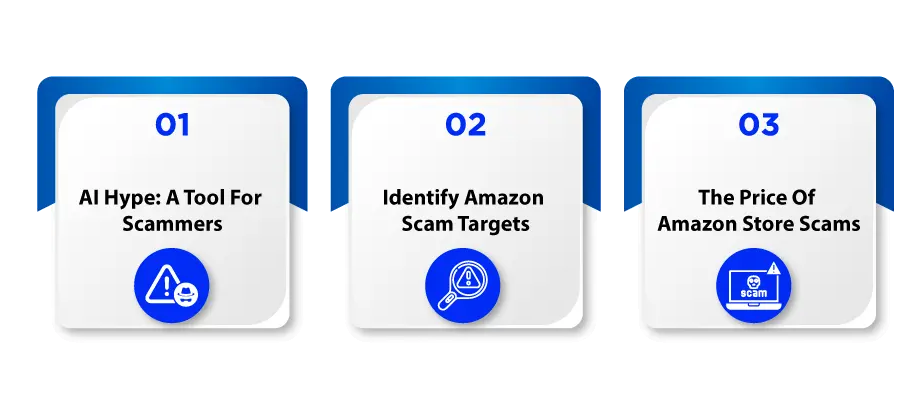
Here is a breakdown of why Amazon automation scams are growing in 2026. Also, the tactics fraudsters use to appear legitimate while targeting new investors.
See How Scammers Use AI Hype to Build False Credibility
The AI boom has made “automation” the most overused word in digital marketing.
Scam operators position their service as an AI-powered Amazon business, backed by slick landing pages, fake webinars, and chatbot sales funnels
The reality is that most of these operators don’t use AI at all. They use the word to make a manual, low-effort service feel like a technological breakthrough.
Know Exactly Who Amazon Automation Scammers Target
Scammers usually target people who have money to invest but little Amazon experience.
This often includes professionals with $20,000–$50,000 in savings, overseas investors entering US e-commerce, and retirees looking for passive income.
If you fall into one of these groups, you’re not naive; you are simply the audience these operators are trained to target.
Recognise the Real Financial Damage Behind Amazon Store Scams
The Federal Trade Commission (FTC) has seen a sharp rise in complaints related to Amazon automation services.
Consumer protection attorneys report that the average victim loses between $20,000 and $75,000, and many discover the fraud only after their refund window has closed.
The Better Business Bureau (BBB) has also flagged multiple Amazon automation companies for patterns of deceptive advertising and non-delivery of services.
15 Red Flags That Expose an Automated Amazon Store Scam
Not every automation agency is a scam, but the fraudulent ones follow a remarkably consistent playbook. Below, the 15 red flags are grouped into four categories so you can spot patterns quickly.
Financial Red Flags
These are the pricing patterns that separate legitimate agencies from operations designed to profit whether your store succeeds or not.
1. Non-Refundable Upfront Fees of $20,000–$50,000
Scam operators front-load their revenue because they know they will not deliver results worth paying for later. If the setup fee is non-refundable and there is no milestone-based payment structure, the operator is optimizing for their cash flow, not your store’s performance.
2. Separate “Ungating” Fees of $1,000–$2,000
Un-gating and getting approved to sell restricted brands is a normal part of Amazon wholesale.
But it doesn’t cost $1,000 per brand. Operators who charge this are monetizing a process that a competent brand approval service includes as part of standard onboarding.
3. Gross Profit Splits of 30–50%
You are providing the capital, the tax ID, and the Amazon account. If the operator is also taking 30–50% of gross profit on top of the upfront fee, the economics do not work in your favor. Read the contract and calculate the math. A one-sided profit split is a fraud signal, not a business model.
4. Rigid Monthly Payments Tied to the Calendar
A fair payment structure ties payments to milestones or deliverables. A scam structure ties them to the calendar. If you are paying $2,500 a month regardless of whether a single product has been listed or a single sale has been made, the operator has no incentive to perform.
5. Exit Fees of 10–15%
Your Amazon account is your asset. An operator who charges 10–15% of the store’s value as an exit fee is monetizing your departure. This clause exists so that leaving the relationship costs more than staying, regardless of whether the service delivers results.
Contract and Legal Red Flags
A contract should protect both parties equally. When it doesn’t, the imbalance is intentional. Pay close attention to the following clauses that govern what happens when things go wrong, because that’s where scam operators reveal their real business model.
6. Gag Clauses with $5,000–$10,000 Penalties
No legitimate agency needs to financially silence its clients. If the contract includes a non-disparagement clause backed by a five-figure penalty, the operator is pre-building a legal wall around future complaints. That is not a partnership it is a muzzle.
7. No Exit Strategy or Termination Rights
A legitimate contract includes a termination clause with defined notice periods and obligations on both sides. If there is no exit mechanism, or if the exit clause is buried under five layers of conditions, the contract is designed to trap you, not serve you.
Think your Amazon store operator might be a scam?
Book a free account audit with Brandock. We’ll review your setup, your contract, and your numbers no obligation.
8. One-Sided Obligations
Read the contract with one question in mind: what happens if the operator underperforms? If the answer is “nothing,” no penalties, no refund triggers, and no performance benchmarks, the contract protects only one party, and it is not you.
9. “Blame Amazon” Escape Clauses
Some operators include clauses that absolve them of liability if Amazon suspends your account. The problem: the suspension was caused by their own actions, policy violations, IP complaints from unauthorized sourcing, or review manipulation. This clause turns their negligence into your legal dead end.
Transparency and Reporting Red Flags
These red flags point to deliberate information gaps designed to keep you dependent and uninformed.
10. Unverifiable Profit Reports
If your operator sends profit reports in PDF or spreadsheet format but will not give you direct access to Seller Central, you have no way to confirm whether those numbers are real. Legitimate reporting means you log in to your own account and verify the data yourself.
11. Mystery Product Sourcing
If you do not know which suppliers your operator is using, you cannot verify whether they are authorized distributors. Unauthorized sourcing puts your account at immediate risk of IP complaints and suspension. A real agency shares supplier names, invoices, and authorization letters without exception.
12. No Verifiable Business Address, Team, or Client References
If you cannot verify where the company is based, who runs it, or speak to a single existing client, you are dealing with a ghost. A real agency has a registered business entity, named team members with verifiable backgrounds, and clients who can confirm their experience.
Operational Red Flags
These patterns signal that your account is being treated as a number in a pipeline rather than a business worth protecting.
13. Running Multiple Stores with Your Capital
When one operator manages dozens of stores with the same sourcing strategy, your account becomes one of many. Accountability drops, communication slows, and when something goes wrong—a suspension, a policy violation, a supplier issue—you are last in line for a fix.
14. Endless “Growth Phases” with No Results
Scammers use stall tactics to push you past refund windows and credit card chargeback deadlines. We’re in the growth phase, which becomes their answer to every question for months.
A real agency sets clear timelines: product research in weeks one through four, first listings live by week six, and first sales within 60–90 days.
15. Guaranteed Income or Unrealistic Passive Income Claims
No legitimate Amazon business guarantees income. Margins fluctuate, competition shifts, and Amazon’s fee structure changes. If someone promises you $5,000 a month in passive income, they are selling you a fantasy, not a business.
What Legitimate Amazon Automation Actually Looks Like
Here’s what a real, transparent Amazon automation setup looks like
Legitimate Amazon Automation Follows a Clear End-to-End Process
A real Amazon wholesale automation service follows a clear process.
It starts with entity formation, moves to account setup, then product research, brand approvals, listing optimization, PPC launch, and ongoing inventory management. Each step is documented.
Each step is verifiable. And each step happens inside your own Amazon Seller Central account, not a mystery dashboard you can’t access.
Transparent Amazon Services Provide Full Access, Reporting, and Clear Fees
Transparent operators provide weekly or biweekly performance reports with real Amazon Seller Central data, not screenshots from unverified sources.
Fee structures are documented in the contract up front: what you pay, when you pay, and which deliverables trigger each payment.
There are no surprise invoices and no “additional processing fees” that appear after onboarding.
How Brandock’s Automation Differs From Scam Services
Brandock, a full-service Amazon agency, was founded in 2020 with a simple rule: your account stays yours fully.
That means you own the Amazon Seller Central login, you see every dollar spent on PPC, and you approve every product before it’s listed.
Our Amazon account management services follow Amazon-compliant workflows: no review manipulation, no grey-market sourcing, and no policy shortcuts that risk your account.
We publish case studies and process documentation openly because that is the standard a legitimate agency should meet.
One of our wholesale partners went from $0 to $20,000 in monthly profit within eight months using our sourcing framework.
That’s a verifiable outcome, not a testimonial on a landing page with no last name attached.
What a Real 60–90 Day Growth Timeline Looks Like
If your operator cannot walk you through a timeline like the one below—with specific outputs at each stage—they do not have a repeatable process.
| Week | Phase | What You Should See |
|---|---|---|
| 1–2 | Entity & Account Setup | LLC formed, EIN issued, Seller Central account created and verified |
| 3–4 | Product Research | Shortlist of 20–40 products with margin analysis and competition data shared with you |
| 5–6 | Sourcing & Approvals | Approval letters from authorized distributors; first purchase orders placed |
| 7–8 | Listings Go Live | Products visible on Amazon with optimized titles, images, and A+ Content |
| 9–10 | PPC Launch | Ad campaigns running; initial keyword data visible in your Seller Central |
| 11–12 | Optimization | First sales data reviewed, bids adjusted, underperforming SKUs flagged |
What to Do If You Fall for an Automated Amazon Store Scam?
Here is what to do immediately if you have fallen victim to an automated Amazon store scam.
Secure Your Account and Save Evidence
Change your Amazon Seller Central password immediately.
Then go to Settings → User Permissions and remove every third-party user the operator added.
If you see an API developer access you don’t recognize, revoke it under Settings → User Permissions → Developer Access.
Take screenshots of the permissions page before and after you make changes, you may need them for your dispute.
Recover Your Money Before Chargeback Deadlines Expire
Credit card chargebacks must be filed within 60–120 days of the transaction, depending on your issuer.
Wire transfers are harder to recover, but not impossible through your bank’s fraud department. If you paid via PayPal, open a dispute immediately.
The longer you wait, the fewer options you have.
File FTC and BBB Complaints Against Amazon Store Fraud
File your complaint through the FTC’s Complaint Assistant at ReportFraud.ftc.gov.
Include every piece of documentation: the contract, payment receipts, email correspondence, screenshots of promises, and a timeline of events.
File a separate complaint with the BBB using the company’s registered name. These filings create a public record that protects future victims and strengthens any legal action you pursue.
Build Strong Documentation for Legal Action and Disputes
Organize your evidence chronologically: initial contact, contract signing, payment records, communications, and the point where delivery failed.
Consult a consumer protection attorney in the operator’s registered state.
Many attorneys offer free consultations for fraud cases, and some handle cases on contingency when documentation is clear.
How To Build A Legitimate Automated Amazon Business The Right Way?
Here is how to build a legitimate automated Amazon business using compliant systems, structured workflows, and proper legal setup from the start.
Automate High-ROI Amazon Tasks Without Losing Control
The four areas with the highest return on automation investment are PPC advertising, inventory replenishment, listing content, and account health monitoring.
These tasks are data-intensive, time-sensitive, and directly tied to revenue. Automating them with a competent operator frees you to focus on strategy and sourcing decisions.
Create a Compliant Wholesale Automation Workflow from Day One
Start with authorized suppliers. Every product you list must come from a source that can provide invoices matching Amazon’s verification requirements.
Build your wholesale supplier pipeline for Amazon FBA before you automate anything else. Clean sourcing is the foundation.
Without it, no amount of PPC spend or listing optimization can save your account from IP complaints.
Protect Your Amazon Business with a Proper US LLC Structure
How To Avoid Automated Amazon Store Scams Before You Pay AnythingIf you’re an international seller targeting the US market, a properly structured Limited Liability Company (LLC) protects your personal assets and establishes your business as a credible US entity.
Brandock’s LLC formation services handle EIN registration, state filing, and bank account setup so your Amazon business starts with a compliant legal foundation.
For sellers transitioning from contractor status, our guide on converting from 1099 to LLC covers the process in detail.
How To Avoid Automated Amazon Store Scams Before You Pay Anything
Scam agencies often look legitimate, so checking contracts, claims, and payment terms before paying can save you from costly mistakes. Let’s discuss them
Verify Every Detail Before Signing an Amazon Automation Agreement
Before you sign, verify the company’s registered business entity, confirm its physical address, and check BBB and FTC records.
Also, read the full contract with a lawyer, speak to at least two current clients, and confirm that you’ll have full Amazon Seller Central access. If any of these steps feel obstructed, walk away.
Pre-Signing Contract Checklist
Before you sign any Amazon automation agreement, run through these ten questions. If more than two answers are “no,” walk away.
- Does the contract list specific deliverables with deadlines (e.g., “first listings live within 6 weeks”)?
- Is there a termination clause that lets you exit with 30 days’ notice or less?
- Does the payment structure tie at least some fees to milestones or deliverables?
- Does the contract confirm you retain full Amazon Seller Central access at all times?
- Are supplier names and authorization requirements documented?
- Is the profit split (if any) calculated on net profit, not gross revenue?
- Does the contract include performance benchmarks that trigger review or fee adjustment?
- Is there a defined process for handling Amazon account suspensions, including who is responsible?
- Can you find the company’s registered business entity through your state’s Secretary of State database?
- Have you spoken to at least two current clients who were not introduced to you by the operator?
What Counts As Legal Fraud Versus An Unfavorable Business Contract
An unfavorable contract is a bad deal. Fraud is a deliberate misrepresentation of services.
If the agency promised results they knew they couldn’t deliver, hid important information, or took payment for services they never planned to provide, it may qualify as fraud.
Identify Fake Amazon Dropshipping Websites Before You Invest
Scam websites typically feature stock imagery, no named team members, generic service descriptions, and urgency-driven CTAs (“Only 3 spots left this month”).
Check the domain age using a WHOIS lookup. Search the site’s testimonial names on LinkedIn.
If nothing checks out, the website is a shopfront for a scam not a service.
Ask Direct Questions During the First Sales Call
Beyond the basics, ask:
- What is your product research methodology?
- Which suppliers do you work with, and are they authorized?
- How do you handle Amazon policy changes?
- What’s your average time to first sale?
- What does your Amazon listing audit process look like?
The depth of their answers tells you whether they’ve actually built and managed stores or whether they’ve only built sales funnels.
Brandock’s Case Study: From Scam Victim to Verified Seller
One Brandock partner came to us after losing $35,000 to an automated Amazon store scam. The previous operator had charged setup fees, collected four months of management fees, and delivered zero live listings.
We onboarded their account in week one, completed brand approvals by week three, launched their first 15 products by week six, and had the store generating revenue by day 72.
Across our active portfolio, partners working with our wholesale automation model have achieved an average of $20,000 in monthly profit within eight months of launch.
PPC-managed accounts maintain an average ACoS below 18%, and zero Brandock-managed accounts have received policy-related suspensions. These are auditable results pulled directly from Seller Central dashboards.
The full process is documented in our FBA wholesale automation case study.
Automated Amazon Store Scam: Frequently Asked Questions Answered
You can spot a scam Amazon automation agency by checking for a few clear warning signs. If they guarantee profits or avoid giving verifiable client case studies, that’s a major red flag. Another warning sign is pressure tactics like “limited spots” or rushing you to sign without due diligence.
Fake reviews follow patterns: identical language across platforms, no verifiable last names, stock profile photos, and testimonials that focus on the sales experience rather than actual store results. If every review says the onboarding was “amazing” but none mention revenue, ACoS (Advertising Cost of Sales), or actual product performance, those reviews were written for the sales funnel not by real clients.
An Amazon dropshipping scam collects upfront fees, creates a Seller Central account in your name, lists a handful of low-quality products from unauthorized suppliers, provides fabricated sales reports, and stalls with “growth phase” excuses until your chargeback deadline passes.
In many cases, yes. File a credit card chargeback within 60–120 days, dispute through PayPal if applicable, and file complaints with the FTC and BBB. Consult a consumer protection attorney for amounts exceeding $10,000. Documentation is critical save every communication and receipt.
A compliant service includes LLC or entity formation, Amazon account setup, product research using demand and margin data, brand approvals through authorized channels, listing creation with A+ Content, PPC campaign management, inventory planning, and ongoing account health monitoring.
Wrapping Up
An automated Amazon store isn’t a scam by default. But the operators who sell it as passive income to people with no Amazon experience? Many of them are. Your best defense is due diligence, clear contracts, and an operator who gives you full access to your own account from day one.
Ready to work with an agency that does things the right way?
Book your free growth call with Brandock. We’ll review your goals, your budget, and your options with full transparency.

 Generating Millions in
